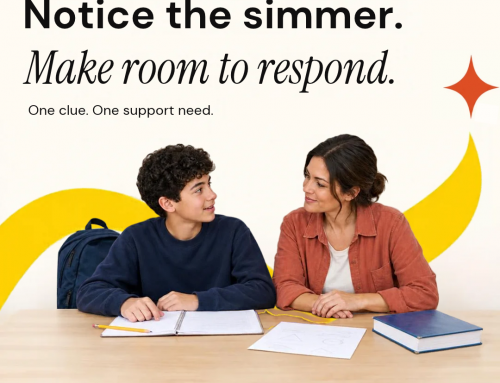
The assignment is open. The cursor is blinking. “Ask your teacher” sounds sensible, except you don’t know what to ask.
Here’s an imagined homework moment: a student understands the topic but can’t tell whether the assignment calls for a summary or an argument. A parent offers to help, and the student says, “I don’t get any of it.” Nobody needs a lecture about trying harder. They need somewhere to begin.
Our earlier Wave Your Hand article opened the conversation about asking for help. This time, let’s make the next step concrete: one useful question, in words you would actually say.
Find the edge of the confusion
Try this invitation: “Show me the last part that made sense.” You don’t have to explain the entire problem before you deserve support.
Maybe the directions make sense until “compare.” Maybe you can solve the example but can’t see how the next problem is different. Maybe you haven’t found a starting point at all. That last answer counts, too.
- If you know where you stopped: “I can do the first part. Could you help me understand what changes here?”
- If the directions are unclear: “Am I explaining what happened, or making a case for what I think?”
- If everything feels tangled: “I’m not sure where I’m stuck yet. Could we look at the directions together?”
These are practice scripts, not passwords that unlock a guaranteed yes. Shorten them, write them down, or use your own words.
Give the request one clear job
Try naming the kind of help you’re looking for: an explanation, an example, help choosing the first step, or someone to stay nearby while you start. “Help me with all of this” is allowed; narrowing it is an option, not an admission requirement.
Here are three possible versions:
- An example: “Could you show me what one finished response should include?”
- A starting point: “Which part would you suggest I tackle first?”
- A check: “I think the next step is to compare these two ideas. Am I reading that correctly?”
For a message to a teacher, you might write: “Hi, I’m working on the comparison assignment. I’m unsure whether each paragraph needs both examples. Could you clarify that part? Thank you.”
No dramatic apology required. You can be courteous without building a courtroom case for needing help.
For parents: offer support without taking the wheel
Before drafting the email for your student, ask what kind of backup they want. Try: “Would you like to say the question out loud, write it together, or have me sit nearby while you send it?”
The aim isn’t independence at any cost. A student may need an adult to advocate, clarify an accommodation, or help find a safer person to ask. Don’t make a polished request a condition of receiving support.
You can also offer a real boundary: “I can read the directions with you for 10 minutes. Then let’s decide whether we need help from someone else.” That is support with an honest shape, not abandonment and not a promise to finish the assignment.
When the answer isn’t yes
A clear request does not control another person’s response. If the person is unavailable, consider asking when they can help, using the school’s established support route, or approaching another trusted adult.
If an interaction feels dismissive or unsafe, a better script may not be the whole answer. You don’t have to keep practicing vulnerability with the same person to prove you tried.
And you don’t have to earn academic support by being charming, saying thank you first, or never having struggled before. Kindness matters; help is not a prize for a flawless reputation.
Parents can practice this, too
If your student’s hesitation feels familiar, you can make your own small request without turning the moment into a story about what’s wrong with either of you. “Could you put that plan in writing?” or “Can we choose which task comes first?” are useful questions to try.
Recognizing yourself in a school-day struggle is not a diagnosis. It can simply be a reason to get curious about what support would make your own day more workable.
One question is enough for today
This is the thread we carry through Orbit & Ember: a kinder interpretation, a usable action, and a place to practice returning to it. No new planner is required for today’s experiment.
- Mindset: “Needing help doesn’t cancel my capability.”
- Skillset: Name one point of confusion or one kind of support.
- Habit: Choose a moment to ask, then note what you learned from the answer.
Try writing one question you’ve been carrying. Decide who might help and how you’d prefer to ask. If the first attempt doesn’t work, adjust the support rather than grading your courage.
For individualized help putting these ideas into practice, explore Yellow Parachute’s executive-function coaching. Bring one ordinary sticking point; you don’t need to arrive with everything figured out.
Yours with a hand in the air,
Cara
Illustrative image created with AI; not a photograph of clients.