You open a planner and love the colors. Your student takes one look and asks, “Where am I supposed to write?”
Neither response needs to win. They are noticing different things, and both are useful starting points for a conversation about the tool.
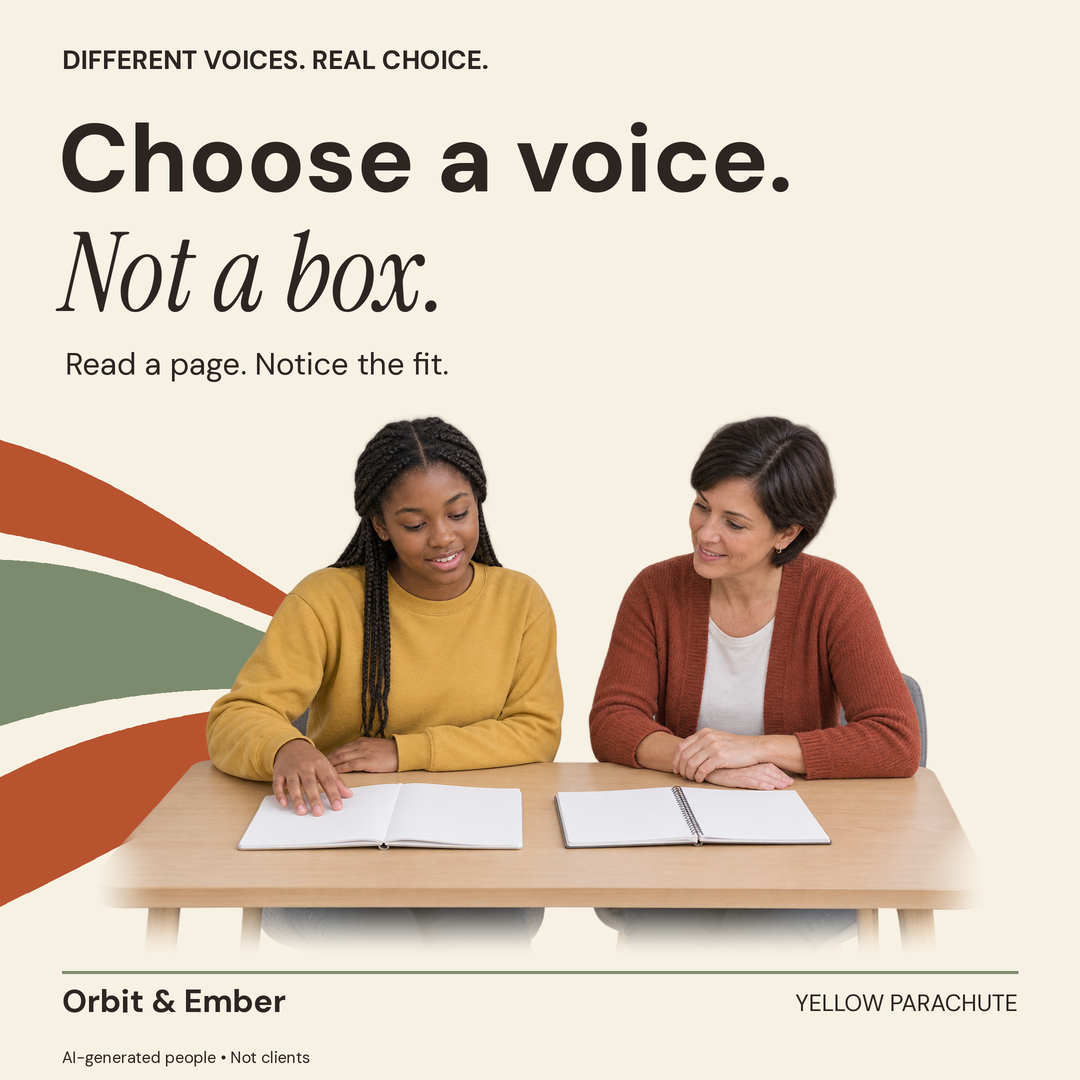
“Choose a voice, not a box” is an invitation to look beyond a label. Consider the language, the amount of structure, and what a page actually asks you to do.
Read one page before deciding
Instead of asking whether an entire planner is “right,” start smaller. Choose one page and read the directions.
Fire & Flare’s middle-school study system asks, “What move can I learn and try?” That question introduces the skillset thread: a move the student can practice.
Own Your Orbit’s “What’s in Your Orbit?” section begins, “Your orbit holds the people, pursuits, and parts of life that matter to you.” It invites the adult to consider which areas of life the planner should make room for.
These are real excerpts from different guides. They are not interchangeable instructions, and the editions are not identical workbooks with different covers.
Notice what feels usable
Try these questions while you look at the page:
- Words: “Can I explain the directions in my own words?” If not, note the phrase that needs clarification.
- Space: “Is there room for the way I write or sketch?” More boxes are not automatically more useful.
- Structure: “Can I see where to begin?” Notice whether the page offers a clear entry point or leaves you guessing.
- Return: “Where would this page live, and when would I open it again?” A tool needs a place in an actual day, not only a place on a desk.
You can like the appearance and still need a different layout. You can also prefer a quiet page without needing to explain or defend that preference.
Try a small piece, not a personality overhaul
Imagine a parent prefers a full weekly view while a student wants to focus on today’s first task. They could keep different planning views and still agree on when to talk about a shared commitment.
That is an illustrative example, not a claim that every edition has the same features. Before adopting a tool, check what that version actually includes and whether it fits the student’s school requirements.
For a manageable trial, choose one page, use it for one real planning moment, and agree on when to review it. “This part helped” and “I didn’t know what to put here” are both useful observations.
Mindset, skillset, habits
- Mindset: “I don’t need to become a different person to try a tool.” Fit is something to explore, not a test of worth.
- Skillset: Read the instruction, identify the first action, and ask about anything unclear.
- Habits: Decide where the page will live and which existing moment will remind you to return to it.
The Orbit & Ember direction is a shared foundation with room for different voices. It is not a requirement that a family use matching words, matching pages, or matching personalities.
If you would like support exploring student planning needs, learn about Yellow Parachute’s coaching approach. There is room to begin with a question rather than a perfectly chosen planner.
Image disclosure: AI-generated people, not clients. Guide excerpts are quoted for discussion; this article does not announce product availability or promise specific results.