By Cara Thorpe, Founder, Yellow Parachute
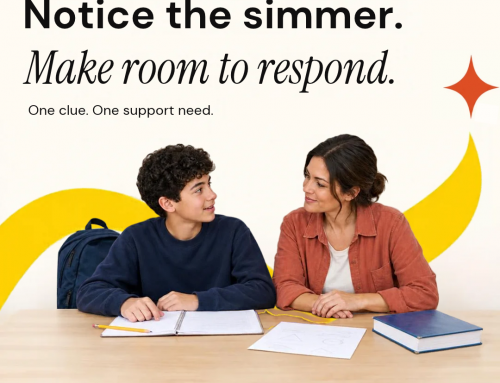
Imagine a student at the kitchen table. The assignment is open, the pencil is nearby, and the first sentence still has not happened. A parent asks, “Have you started?” Neither person feels better after the answer.
Task initiation is the ability to begin a task in a timely way, without undue procrastination, in the Dawson and Guare executive-skills framework. Their suggested supports include making the first demand smaller, providing a cue, walking through the first step, and making help available. (Dawson and Guare, pp. 27 and 30)
For this week’s experiment, let’s treat the starting line as something to investigate, not a test of character. We are not trying to win an argument about effort. We are looking for one workable beginning.
Mindset: get curious about the starting line
Instead of “Why haven’t you done it yet?” try “Show me where the first step gets fuzzy.” Then leave room for an answer you did not expect.
Maybe the student does not know what the teacher wants. Maybe the materials are missing, the first step feels too large, or they need a break before another demand. Those are possibilities to check together, not conclusions to draw from a closed notebook.
For a parent, this is also a useful mirror. Think of the form you keep reopening or the email that has become its own household resident. You can practice a kinder question for yourself without turning your child’s homework into a lesson about you.
Skillset: make the first action visible
Try a starting plan with three parts: the action, the cue, and the help available. Choosing a cue with the student and limiting the initial demand are consistent with Dawson and Guare’s task-initiation supports. (Dawson and Guare, p. 30)
- The action: Replace “do the essay” with “open the directions and underline what I need to turn in.” It should be something you could see someone doing.
- The cue: Agree on when that action will happen. “After my snack, I will put the directions beside my notebook” is one possible cue, not a rule for every student.
- The help: Ask, “Would you like me nearby, one question answered, or space to try?” Agree on support rather than assuming that closer supervision is always welcome.
A short beginning can be enough for an experiment. If a timer helps, choose a brief interval together and honor the agreed stopping point; two minutes is an option, not a research-backed magic number or a promise that momentum will take over.
Here is a made-up example: a student starts a history assignment by opening the instructions and writing one question about them. If the instructions are still unclear, the next useful action may be asking the teacher, not pushing through confusion.
Habits: keep a cue worth returning to
After trying the first step, ask two questions: “What helped you begin?” and “What should we change next time?” Keep the answer brief enough to use tomorrow.
This is the Orbit & Ember thread: a kinder mindset, a practical skillset, and habits you can return to. A planning page can hold the cue and the next action without becoming one more performance to perfect.
Starting is not the same as finishing. Before stopping, leave a short return note such as “Next: choose one example for paragraph one.” If starting remains difficult, bring that information to the student’s teacher or support team rather than treating the experiment as a verdict.
This week’s small experiment
Choose one real assignment and write: “After ___, I will ___.” Make the second blank a visible action, and agree on what help is available.
Try it once, then adjust. The goal is not a flawless evening; it is a beginning you can understand and practice.
If your family would like support working through these moments, explore Yellow Parachute’s executive-function coaching. Bring the real assignment, the real schedule, and the part that keeps getting stuck.
Yours in the next small step,
Cara